Deliveries & logistics without spreadsheet coordination or shipping delays
Shipping teams update carrier portals by hand, chase transport confirmations, and rebuild export docs across tools that don't talk. Piston runs delivery, transport, and logistics documentation as one system.

Ship without the customs scramble
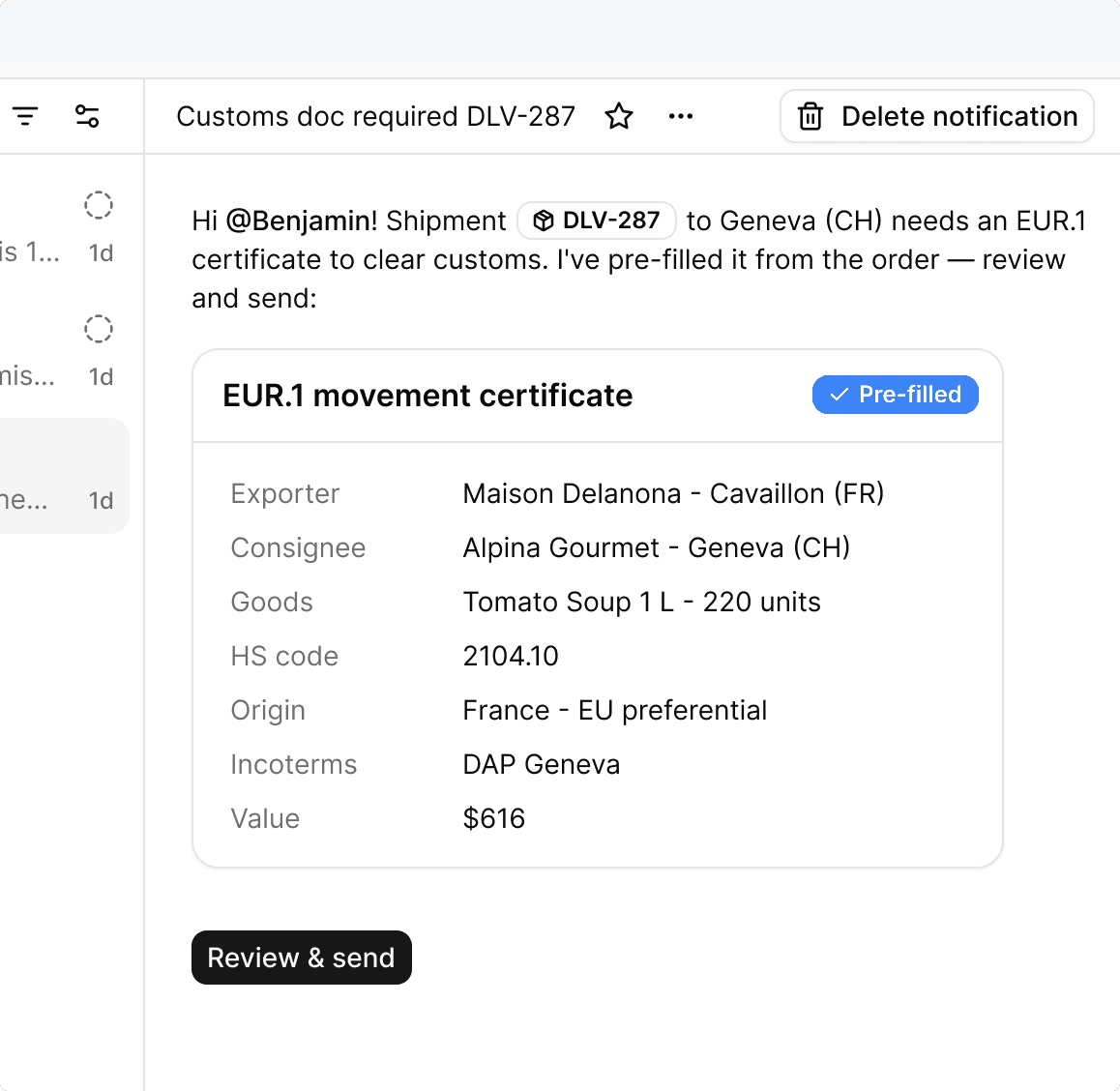
Piston generates customs calculations and export documents straight from the shipment. Paperwork ready before the truck is.
Generate customs calculations and export documentation automatically
Hold shipment data, Incoterms, carrier info, and customs references in one place

Track every delivery from dispatch to doorstep
Piston runs delivery execution alongside orders, inventory, and warehouse activity. One system from picking to doorstep.
Track deliveries, dispatches, carrier assignments, and status in real time
Spot delayed shipments and blocked deliveries early enough to react
Keep logistics, warehouse, and service on the same delivery data
Shipping documents that build themselves
Piston produces every shipping document from the shipment itself. Pick the order, the paperwork is already right.
Generate packing slips, transport docs, and carrier labels automatically
Produce customs paperwork with no manual re-entry

Numbers when logistics runs on Piston

-70
%
Faster document generation
Shipping docs in seconds, not minutes
-35
%
Fewer delivery delays
The agent flags issues before dispatch
-90
%
Less manual re-entry
Customs and carrier docs auto-built

Key logistics system features
Delivery tracking
Track every shipment from dispatch through final delivery with real-time status updates that keep customer service, operations, and logistics teams aligned on delivery progress.
Shipping document generation
Generate delivery notes, packing lists, transport documents, and customs paperwork directly from shipment records eliminating manual preparation and ensuring documentation is accurate and complete.
Customs documentation
Generate and maintain the customs documentation required for cross-border shipments ensuring accurate declarations, certificates of origin, and trade compliance records are available for every international shipment.
Shipment coordination
Plan and execute outbound shipments with full visibility into what needs to ship, when, and by which carrier reducing delays, errors, and costly last-minute logistics decisions.
Warehouse dispatch visibility
Coordinate outbound flows between warehouse operations and logistics teams giving both a shared view of what is ready to ship, staged, or awaiting carrier pickup at any moment.
Logistics exception management
Surface delivery delays, carrier issues, customs holds, and shipment exceptions as they occur giving logistics and customer service teams the visibility to resolve problems before they impact customers.
Carrier management
Manage relationships with multiple carriers from one place storing rate agreements, service levels, and performance data so teams can make informed routing decisions on every shipment.
Export workflow management
Manage export-specific requirements customs classifications, origin declarations, and trade compliance checks within standard shipping workflows so teams stay compliant without adding manual overhead.
Built for companies that produce goods.
Where physical operations meet real constraints.

Food and beverages
Coordinate production runs, batch traceability, supplier quality, and regulatory compliance in one operational workspace. Piston keeps your production floor and back-office data synchronized, with AI agents handling the routine coordination work.

Distribution
Manage orders, stock, suppliers, and customer relationships in one operational workspace. Piston keeps your sales pipeline and supply chain in sync, with AI agents handling the routine coordination work.

Manufacturing
Run production, inventory, procurement, and finance in one operational workspace. Piston keeps shop-floor reality and back-office data in sync, with AI agents handling the repetitive coordination work.
FAQ
Does Piston automate logistics operations without human validation?
No. Piston assists sales and operations teams by centralizing order visibility, automating routing decisions, detecting fulfillment exceptions, and coordinating invoicing workflows, but operational decisions remain fully controlled by teams. Sales managers, operations teams, and customer service still validate order priorities, manage fulfillment exceptions, approve high-value orders, and handle customer commercial conditions. The objective is not to automate order management blindly. The objective is to reduce the manual coordination overhead created by fragmented order entry, disconnected fulfillment systems, and repetitive invoicing administration.
How much manual logistics work can teams reduce?
Many industrial sales and operations teams still re-enter orders manually, coordinate fulfillment through emails and spreadsheets, and generate invoices separately from operational events. Piston reduces this overhead by connecting order capture, fulfillment routing, inventory allocation, and invoicing inside one operational workflow synchronized in real time. Orders, stock reservations, fulfillment status, and billing remain aligned automatically instead of requiring manual coordination across sales, warehouse, logistics, and finance teams. Teams spend less time processing orders administratively and more time managing customer priorities and operational exceptions.
What makes Piston different from a traditional logistics ERP workflow?
Traditional ERP order management workflows are often rigid, fragmented, and slow to reflect real operational activity. Orders are entered manually. Fulfillment routing depends on spreadsheets. Invoicing happens separately from delivery confirmation. Customer service lacks visibility into operational status. Piston connects order management directly to inventory, warehouse, production, logistics, and finance operations inside one shared workspace. Sales teams, operations, and customer service maintain real-time visibility across order status, fulfillment progress, and payment activity without relying on disconnected systems and manual status updates.
Can Piston support complex industrial shipping and export operations?
Yes. Piston is designed for industrial B2B environments where orders depend on customer-specific pricing, volume conditions, production dependencies, multi-site fulfillment, and commercial approval workflows. The platform supports make-to-order operations, blanket orders, customer price books, EDI integrations, 3PL coordination, and order-to-cash tracking across complex industrial sales environments. Operational teams can adapt order workflows according to customer requirements and operational constraints instead of forcing order activity into rigid ERP processes.
Why do industrial companies modernize logistics workflows?
As industrial B2B operations grow more complex, order coordination becomes increasingly difficult to manage manually. Sales and operations teams often rely on spreadsheets, manual ERP entry, email-based fulfillment coordination, and disconnected invoicing workflows to process customer orders. This creates entry errors, fulfillment delays, billing mistakes, and poor visibility across sales, operations, and finance teams. Industrial companies modernize order management to centralize order operations, automate fulfillment routing, improve order-to-cash performance, and give teams real-time visibility across the full order lifecycle without increasing coordination overhead.