Finance without manual reconciliation or fragmented data
Finance teams match invoices by hand, chase PO approvals, and rebuild reports from data spread across tools. Piston runs AP, AR, invoice reconciliation, and financial workflows as one system.

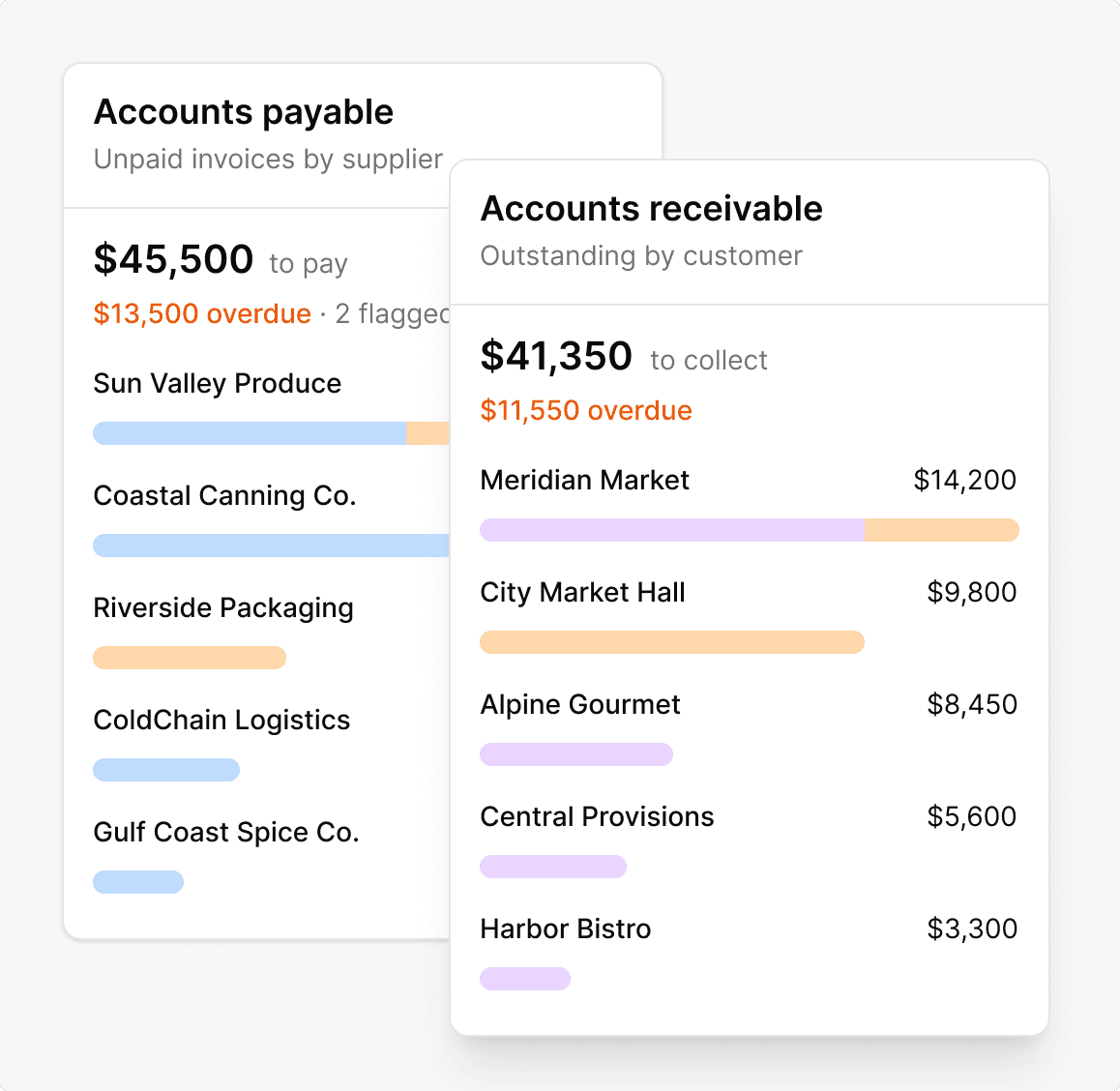
AP and AR in one place, matched automatically
Piston handles payables and receivables from the same validated order and delivery data. One flow, both directions.
Automate 3-way matching across purchase orders, receipts, and invoices
Generate customer invoices from validated orders and deliveries
Track payment status, balances, and collections in real time

Close the books without the manual chase
Piston reconciles transactions against operational events as they happen. The books stay matched all month.
Match financial transactions to operational events across procurement and sales
Surface unmatched invoices and pending approvals early
Your books, already reconciled
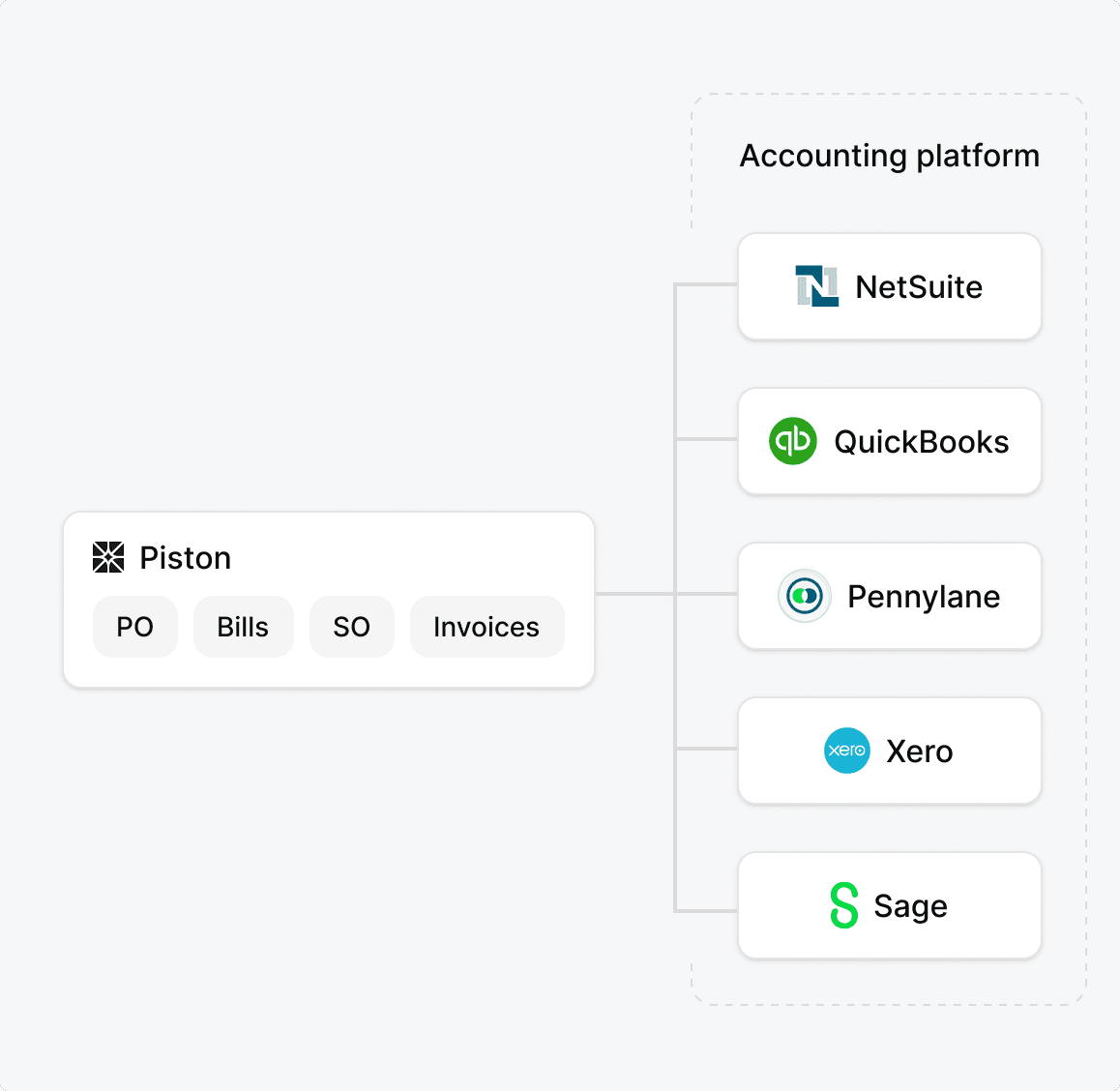
Every transaction posts with landed costs and COGS already attributed, so your accounting system receives clean, reconciled data
Post POs, bills, sales orders, and invoices to the GL in real time
Attribute landed costs, COGS, and expenses at the transaction level
Run month-end close on data that is already reconciled
Numbers when finance runs on Piston

-80
%
Lower invoice cost
Manual invoice handling, mostly gone
10
x
Faster invoice processing
Approvals in a day, not weeks
-80
%
Fewer reconciliation errors
Gaps caught before payment goes out

Key finance & accounting system features
AP automation
Automate accounts payable processes from invoice receipt through validation and payment reducing manual processing, accelerating payment cycles, and maintaining accurate supplier account records.
Approval workflow routing
Route financial documents through configurable approval chains based on amount, type, or business unit capturing authorization in the system and creating a complete audit trail for every transaction.
Procure-to-pay automation
Connect the entire purchasing cycle from requisition through payment in one automated flow eliminating handoffs between disconnected tools and ensuring every transaction is documented and auditable.
AR management
Manage customer invoices, payment tracking, and collection workflows in one place reducing days sales outstanding and giving finance teams clear visibility into outstanding receivables at all times.
Cost control & margin tracking
Monitor actual costs against budgets and purchasing commitments in real time giving finance and operations teams the visibility needed to protect margins and control spending before it escalates.
Order-to-cash tracking
Follow every customer transaction from order confirmation through invoicing and payment receipt giving finance teams full visibility into the revenue cycle and accelerating cash collection.
3-way invoice matching
Automatically match supplier invoices against purchase orders and goods receipts identifying discrepancies before payment is approved and eliminating the manual verification effort that slows finance teams down.
Financial reconciliation
Reconcile accounting entries against operational records (purchase orders, deliveries, and invoices) automatically, reducing end-of-period workload and improving the accuracy of financial reporting.
Built for companies that produce goods.
Where physical operations meet real constraints.

Food and beverages
Coordinate production runs, batch traceability, supplier quality, and regulatory compliance in one operational workspace. Piston keeps your production floor and back-office data synchronized, with AI agents handling the routine coordination work.

Distribution
Manage orders, stock, suppliers, and customer relationships in one operational workspace. Piston keeps your sales pipeline and supply chain in sync, with AI agents handling the routine coordination work.

Manufacturing
Run production, inventory, procurement, and finance in one operational workspace. Piston keeps shop-floor reality and back-office data in sync, with AI agents handling the repetitive coordination work.
FAQ
Does Piston replace our existing accounting software?
No. Piston assists sales and operations teams by centralizing order visibility, automating routing decisions, detecting fulfillment exceptions, and coordinating invoicing workflows, but operational decisions remain fully controlled by teams. Sales managers, operations teams, and customer service still validate order priorities, manage fulfillment exceptions, approve high-value orders, and handle customer commercial conditions. The objective is not to automate order management blindly. The objective is to reduce the manual coordination overhead created by fragmented order entry, disconnected fulfillment systems, and repetitive invoicing administration.
How much manual finance work can teams reduce?
Many industrial sales and operations teams still re-enter orders manually, coordinate fulfillment through emails and spreadsheets, and generate invoices separately from operational events. Piston reduces this overhead by connecting order capture, fulfillment routing, inventory allocation, and invoicing inside one operational workflow synchronized in real time. Orders, stock reservations, fulfillment status, and billing remain aligned automatically instead of requiring manual coordination across sales, warehouse, logistics, and finance teams. Teams spend less time processing orders administratively and more time managing customer priorities and operational exceptions.
What makes Piston different from a traditional finance ERP module?
Traditional ERP order management workflows are often rigid, fragmented, and slow to reflect real operational activity. Orders are entered manually. Fulfillment routing depends on spreadsheets. Invoicing happens separately from delivery confirmation. Customer service lacks visibility into operational status. Piston connects order management directly to inventory, warehouse, production, logistics, and finance operations inside one shared workspace. Sales teams, operations, and customer service maintain real-time visibility across order status, fulfillment progress, and payment activity without relying on disconnected systems and manual status updates.
Can Piston handle complex industrial AP/AR workflows?
Yes. Piston is designed for industrial B2B environments where orders depend on customer-specific pricing, volume conditions, production dependencies, multi-site fulfillment, and commercial approval workflows. The platform supports make-to-order operations, blanket orders, customer price books, EDI integrations, 3PL coordination, and order-to-cash tracking across complex industrial sales environments. Operational teams can adapt order workflows according to customer requirements and operational constraints instead of forcing order activity into rigid ERP processes.
Why do industrial companies modernize finance and accounting workflows?
As industrial B2B operations grow more complex, order coordination becomes increasingly difficult to manage manually. Sales and operations teams often rely on spreadsheets, manual ERP entry, email-based fulfillment coordination, and disconnected invoicing workflows to process customer orders. This creates entry errors, fulfillment delays, billing mistakes, and poor visibility across sales, operations, and finance teams. Industrial companies modernize order management to centralize order operations, automate fulfillment routing, improve order-to-cash performance, and give teams real-time visibility across the full order lifecycle without increasing coordination overhead.