Demand planning without spreadsheet forecasts or reactive replenishment
Planning teams rebuild forecasts by hand, reconcile sales and inventory data across tools that don't talk, and make replenishment calls with no reliable read on demand. Piston runs forecasting, S&OP, and replenishment as one system.

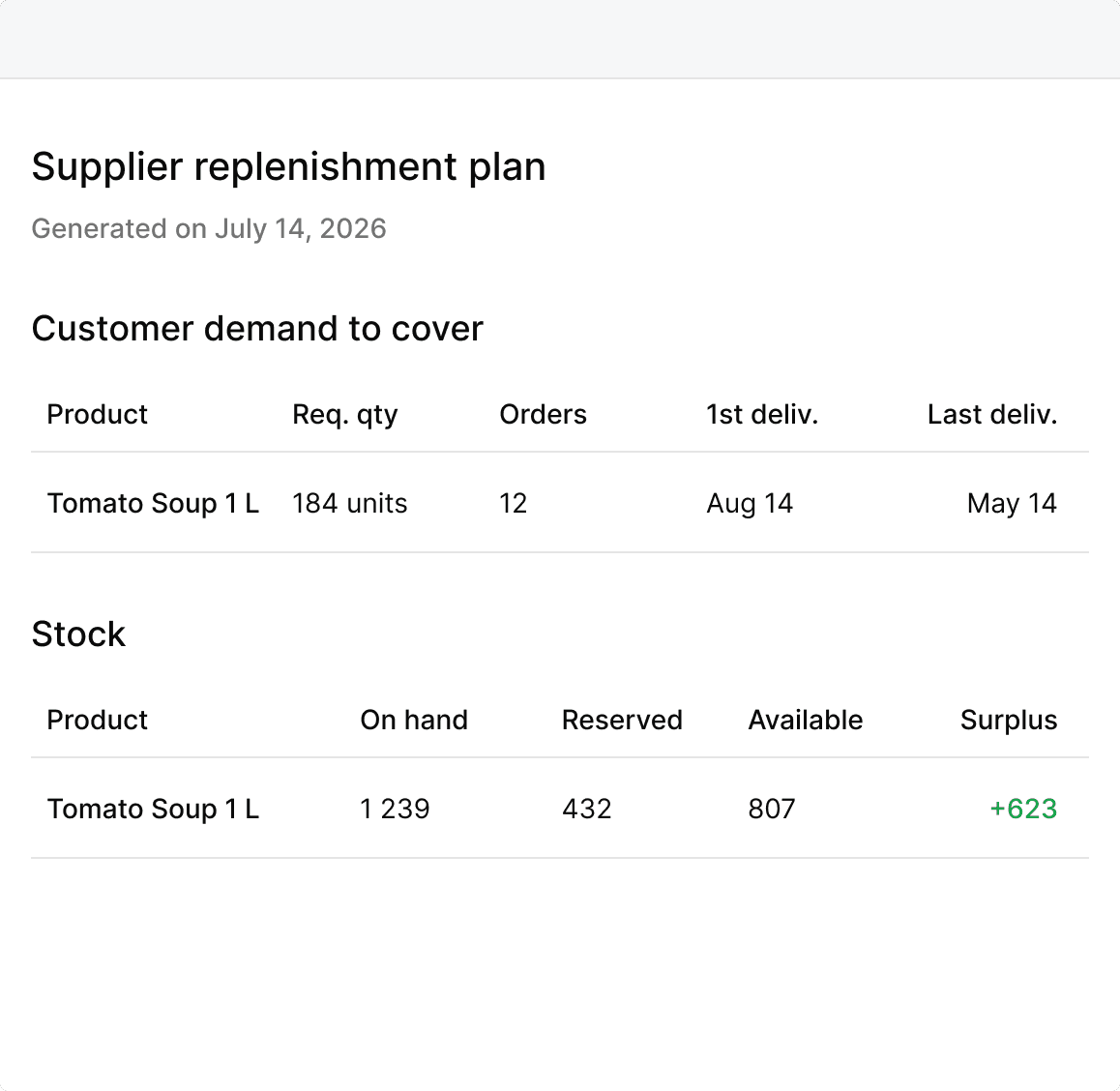
Replenishment that stays ahead of demand
Piston calculates what to reorder from live demand and inventory, in time to act on it.
Calculate replenishment needs dynamically from forecasts and live stock positions
Time every order to supplier lead times and production requirements
Surface coverage gaps, shortage risks, and excess stock early


Forecasts built on what actually happened
Piston forecasts from live data across your whole operation. Sales history, seasonality, and demand signals in one model.
Generate forecasts from sales history, seasonal patterns, and demand signals
Set planning horizons by product, category, customer, or period
Spot demand shifts and forecast deviations before they reach inventory
Align sales, capacity, and supply in one plan
Piston holds the whole S&OP picture in one place. Demand, capacity, stock, and cash in the same view.
Align sales plans with production capacity and inventory
See gaps between forecasted demand and supply capacity early
Coordinate planning across sales, operations, finance, and procurement
Numbers when demand planning runs on Piston

+25
%
Higher forecast accuracy
Forecasts built on live operating data
-20
%
Lower safety stock
Buffer stock cut without more stockouts
-20
%
Fewer stockouts
Coverage gaps surfaced before hitting sales

Key demand planning system features
Demand forecasting
Generate forward-looking demand forecasts using historical sales data, consumption trends, and market signals reducing reliance on intuition and improving purchasing and production accuracy.
ABC / SKU prioritization
Classify products by consumption value and criticality concentrating planning effort and safety stock investment on the SKUs that drive the most operational and commercial impact.
Seasonal demand adjustment
Account for seasonal patterns, promotional peaks, and event-driven demand spikes in planning cycles ensuring supply is positioned ahead of predictable volume changes rather than reacting to them.
S&OP coordination
Align sales, operations, and finance teams around a shared demand plan providing the structured process needed to balance commercial commitments with supply chain and production capacity.
Safety stock optimization
Calculate safety stock levels based on demand variability, supplier lead times, and service level targets reducing both stockouts and unnecessary capital tied up in excess inventory.
Multi-site demand visibility
Consolidate demand signals from all sites, channels, and distribution points into one planning view enabling more accurate network-level decisions on stock positioning and replenishment priorities.
Replenishment planning
Translate demand forecasts into actionable replenishment recommendations triggering purchase or production orders at the right time to maintain target stock levels across the supply network.
Reorder point management
Set and maintain dynamic reorder points for every SKU factoring in current consumption rates, lead times, and safety stock buffers to trigger replenishment before stock runs out.
Built for companies that produce goods.
Where physical operations meet real constraints.

Food and beverages
Coordinate production runs, batch traceability, supplier quality, and regulatory compliance in one operational workspace. Piston keeps your production floor and back-office data synchronized, with AI agents handling the routine coordination work.

Distribution
Manage orders, stock, suppliers, and customer relationships in one operational workspace. Piston keeps your sales pipeline and supply chain in sync, with AI agents handling the routine coordination work.

Manufacturing
Run production, inventory, procurement, and finance in one operational workspace. Piston keeps shop-floor reality and back-office data in sync, with AI agents handling the repetitive coordination work.
FAQ
Does Piston automate demand planning decisions without human validation?
No. Piston assists sales and operations teams by centralizing order visibility, automating routing decisions, detecting fulfillment exceptions, and coordinating invoicing workflows, but operational decisions remain fully controlled by teams. Sales managers, operations teams, and customer service still validate order priorities, manage fulfillment exceptions, approve high-value orders, and handle customer commercial conditions. The objective is not to automate order management blindly. The objective is to reduce the manual coordination overhead created by fragmented order entry, disconnected fulfillment systems, and repetitive invoicing administration.
How much manual planning work can teams reduce?
Many industrial sales and operations teams still re-enter orders manually, coordinate fulfillment through emails and spreadsheets, and generate invoices separately from operational events. Piston reduces this overhead by connecting order capture, fulfillment routing, inventory allocation, and invoicing inside one operational workflow synchronized in real time. Orders, stock reservations, fulfillment status, and billing remain aligned automatically instead of requiring manual coordination across sales, warehouse, logistics, and finance teams. Teams spend less time processing orders administratively and more time managing customer priorities and operational exceptions.
What makes Piston different from a traditional demand planning ERP?
Traditional ERP order management workflows are often rigid, fragmented, and slow to reflect real operational activity. Orders are entered manually. Fulfillment routing depends on spreadsheets. Invoicing happens separately from delivery confirmation. Customer service lacks visibility into operational status. Piston connects order management directly to inventory, warehouse, production, logistics, and finance operations inside one shared workspace. Sales teams, operations, and customer service maintain real-time visibility across order status, fulfillment progress, and payment activity without relying on disconnected systems and manual status updates.
Can Piston support complex industrial demand planning environments?
Yes. Piston is designed for industrial B2B environments where orders depend on customer-specific pricing, volume conditions, production dependencies, multi-site fulfillment, and commercial approval workflows. The platform supports make-to-order operations, blanket orders, customer price books, EDI integrations, 3PL coordination, and order-to-cash tracking across complex industrial sales environments. Operational teams can adapt order workflows according to customer requirements and operational constraints instead of forcing order activity into rigid ERP processes.
Why do industrial companies modernize demand planning workflows?
As industrial B2B operations grow more complex, order coordination becomes increasingly difficult to manage manually. Sales and operations teams often rely on spreadsheets, manual ERP entry, email-based fulfillment coordination, and disconnected invoicing workflows to process customer orders. This creates entry errors, fulfillment delays, billing mistakes, and poor visibility across sales, operations, and finance teams. Industrial companies modernize order management to centralize order operations, automate fulfillment routing, improve order-to-cash performance, and give teams real-time visibility across the full order lifecycle without increasing coordination overhead.